


On April 19, 2021, NASA’s Ingenuity Mars Helicopter made history by achieving the first powered controlled flight on another planet. Now that’s pretty cool, but what was meant to be a brief 30-day technology demonstration, turned into seventy-two flights across three years. It had completely rewritten the playbook for planetary exploration.
Now, NASA is taking its aerial revolution to its next evolution. Albeit, a dramatically ambitious evolution. Mission Skyfall.
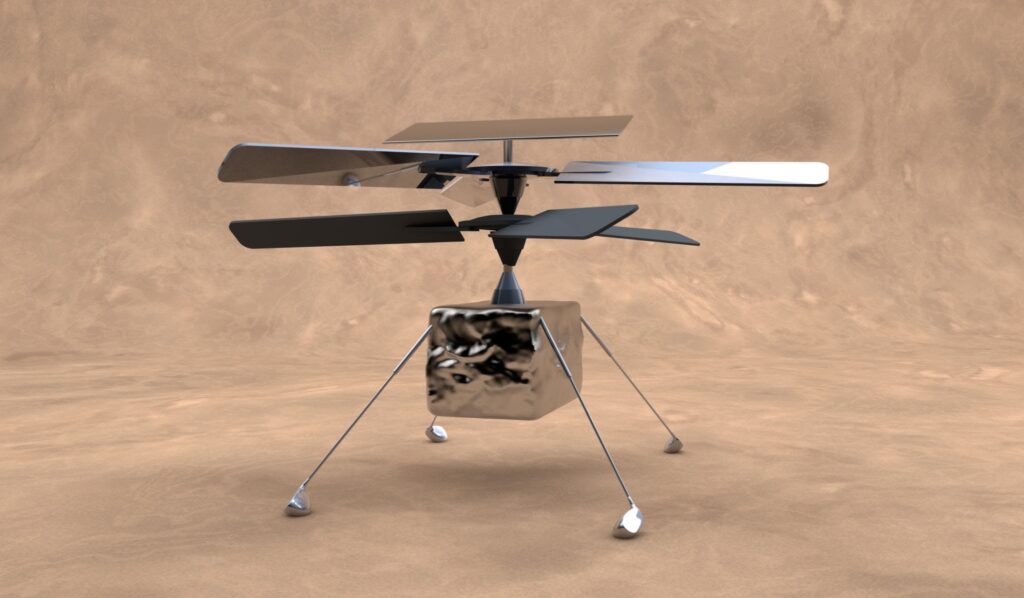
Source: Devrimb / Getty Images
The Skyfall
Yeah it’s a little bit James Bond, but unlike Ingenuity, which was safely tucked away inside the Mars Perseverance rover, the Skyfall craft won’t have any ground carrier for assistance. Instead, it will fall from the sky. There will be three, third gen helicopters making a high stakes arrival.
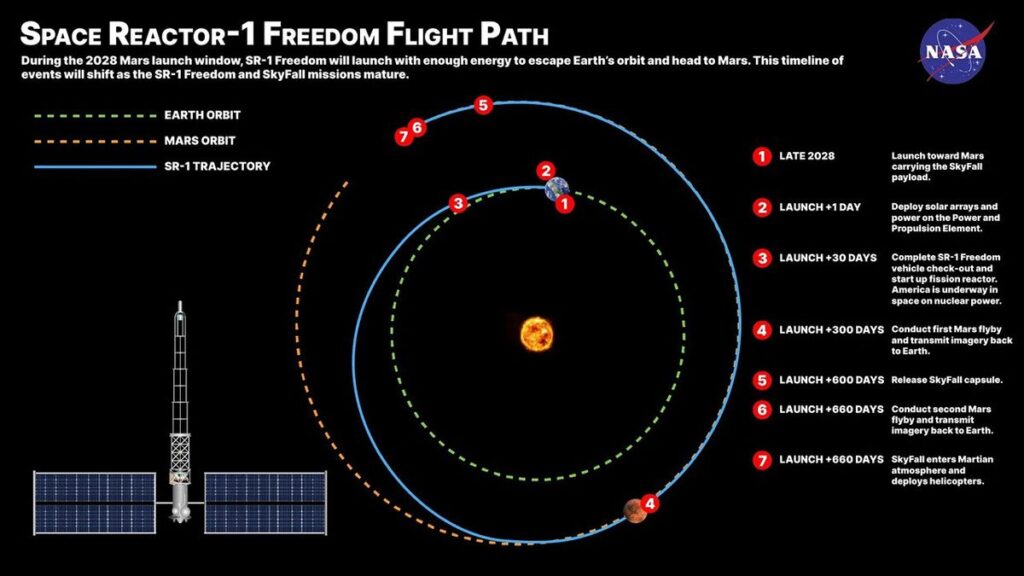
Onboard the SR-1 Freedom, which will be humanity’s first fission-powered interplanetary spacecraft, set to launch in 2028, the three helicopters will make their way to Mars. While the SR-1 Freedom is making its way through the Martian atmosphere the Skyfall vehicles will be released during the descent, and starting their flight sequences mid-air and flying themselves through to a delicate touchdown on the dusty red terrain. Once there, the three will operate independently of each other, communicating directly with orbital relays and coordinating with each other to survey the vast uncharted terrain.
What Will Skyfall Do?
Essentially we’re going to have compact flying laboratories flying around carrying a heavy payload of scientific instruments. The total bill weighing in at just 5kgs, or 11 pounds each. What will they do?
- Subsurface Water: Each of these little labs will carry a compact Ground-Penetrating Radar (GPR) that is capable of probing beneath the topsoil and all the way down to depths of 10 feet (3 meters). This allows the mapping of hidden reserves of water ice which is crucial for not only unraveling Mars’ climate history but for sourcing life support and rocket propellant for future human missions.
- 3d Terrain Mapping: The trio will be armed with 13-megapixel visible and near-infrared cameras, which they’ll use to reconstruct 3d terrain maps to pinpoint safe landing corridors and mineral-rich zones.
- Riding Martian Winds: By using their ability to hover at certain altitudes, these rotorcraft will measure the atmospheric temperatures, wind speed, and the wind direction, across vertical profiles. This data is normally impossible to collect with traditional ground rovers or high-altitude orbiters.
- Radiation Profiles: All of the above have been of high importance, but perhaps the most important, is to help mission planners understand the environment for future human astronauts by using the micro-dosimeters attached to the Skyfall helicopters. The fleet will map the surface radiation exposure.
Key Mission Fast Facts
| Feature | Details |
| Scheduled Launch | Late 2028 (Landing Fall 2030) |
| Delivery Spacecraft | SR-1 Freedom (Fission/Nuclear Electric Propulsion) |
| Fleet Size | 3 autonomous rotorcraft |
| Rotor Diameter | 4.4 feet (1.35 meters) counter-rotating blades |
| Ground Radar Range | 1.6 to 10 feet (0.5 to 3.0 meters) depth |
| Primary Industry Partner | AeroVironment / NASA Jet Propulsion Laboratory |
These three little drones are at the forefront of making the transition from simple surface exploration, to dynamic, multi-dimensional planetary surveying.
Check out the in-depth mission over at the NASA website: https://science.nasa.gov/mission/skyfall/
 GS Team
 Kate Bishop
 Adam Morris