


It seems like the James Webb Space Telescope is making discoveries constantly, well, it is in fact a modern marvel right? Never before have we been able to see such things, like the most earliest formed galaxy, which is called MoMz14, which was only formed 280 million years after the big bang. So we’re talking about seeing a galaxy that the light has taken over 13 billion years to reach the lense. OR another notable find is an image of a solar system being born, deep in the Orion Nebula. Take our Know Your Nebula quizz if you think you know them. BUT perhaps one of the most intriguing images is that of 20 connected galaxies that make us rethink our understanding of galactic models.
What Is The Cosmic Vine?
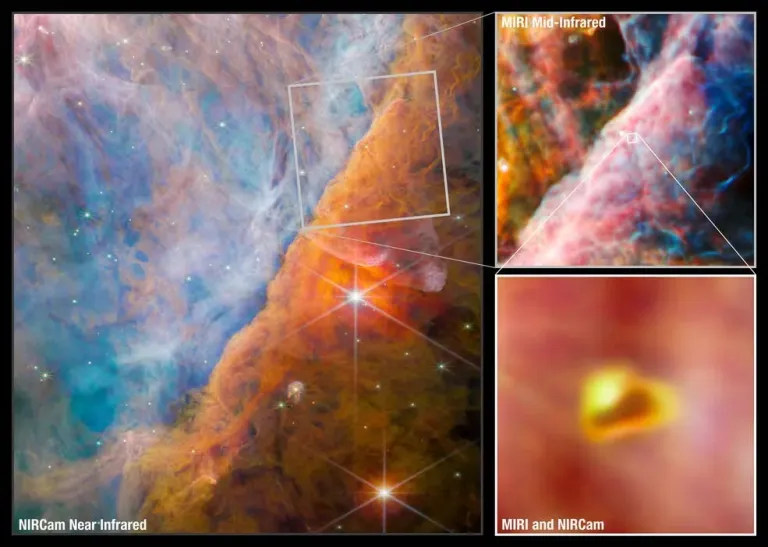
These Webb images show a part of the Orion Nebula known as the Orion Bar. The largest image, on the left, is from Webb’s NIRCam (Near-Infrared Camera) instrument. At upper right, the telescope is focused on a smaller area using Webb’s MIRI (Mid-Infrared Instrument). At the very center of the MIRI area is a young star system with a protoplanetary disk named d203-506. The pullout at the bottom right displays a combined NIRCam and MIRI image of this young system.
The early universe is full of intruge and chaos, where things smash and heat and cool all in a rapid succession. So, you see, a collection of 20 connected galaxies that formed very early in the universe does challenge our current understanding of what was actually going on back then. These cosmic vine galaxies formed 830 million years after the big bang, so close to 12 billion years ago. Collectively, the structure spans 13 million light years long. Let’s take a look at the actual images.
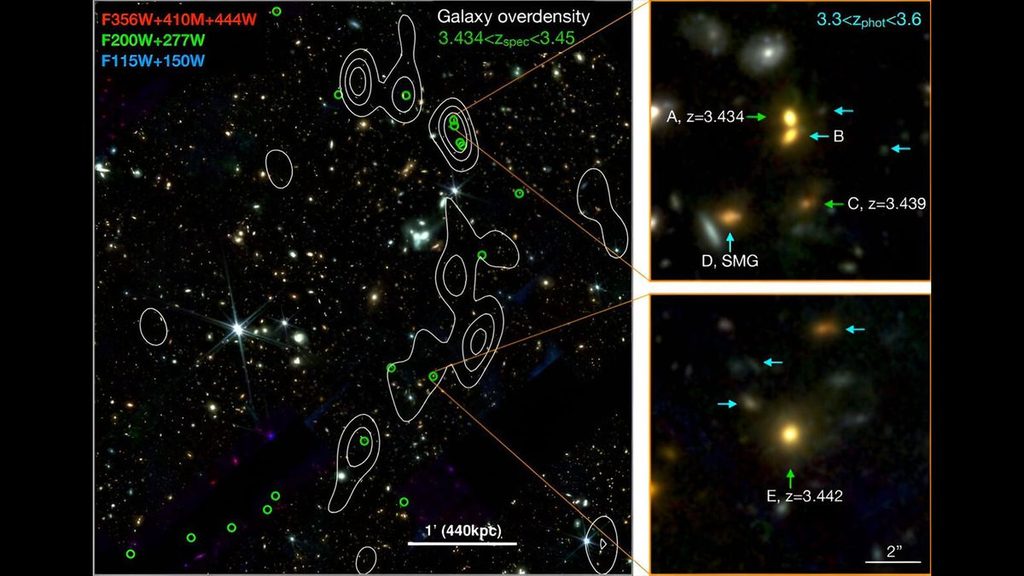
This is astonishing. You can see in the images, some clustering of the galaxies, almost touching I guess. Although the structure is 13 million light years long, it is only a mere 650,000 light years wide. This is nothing to sneeze at, our Milky Way Galaxy is 100,000 light years wide.
Large And In Charge
Yes, there has been other galaxy groups found in the early universe but the Cosmic Vine is significantly larger that the others. According to researchers this structure is slowing merging into a galaxy cluster, which are considered the most massive structures in the cosmos. The difference being, clusters are bound together by gravity, meaning there are usually hundreds of billions to quadrillions of times the mass of our sun.
The Cosmic Vine is currenly a light-weight in the ring, only having an estimated mass of 260 billion solar masses, but it’s still growing. However, two of its largest galaxies appear to have matured. While studying the wavelengths of light emitted by the two, researches found that star formation had all but stopped there.
It’s just another great example of what natuarl mysteries are out there just waiting to be discovered.
Don’t Miss…
- NASA Selects Blue Origin as Mars Telecommunications Network Provider

- Cosmic Vine of 20 Connected Galaxies Makes us Rethink Galactic Models

- Star Wars LEGO Smart Play is here, but where are the Marvel ones?

- NASA’s SkyFall Helicopters Getting Ready for Liftoff

- Six Numbers That Run Our Universe

- 10,000 Drones Are Headed To Saturn’s Rings

 Adam Morris