

If you’re into the same things as I am, you would have been hit last year with photos of quantum computers. But they aren’t actually what you’re imagining.
So, you would have seen these types of photos swirling around the “hypesphere” of the internet. But these shots are taken like this for a reason…to captivate the imagination and build the hype.
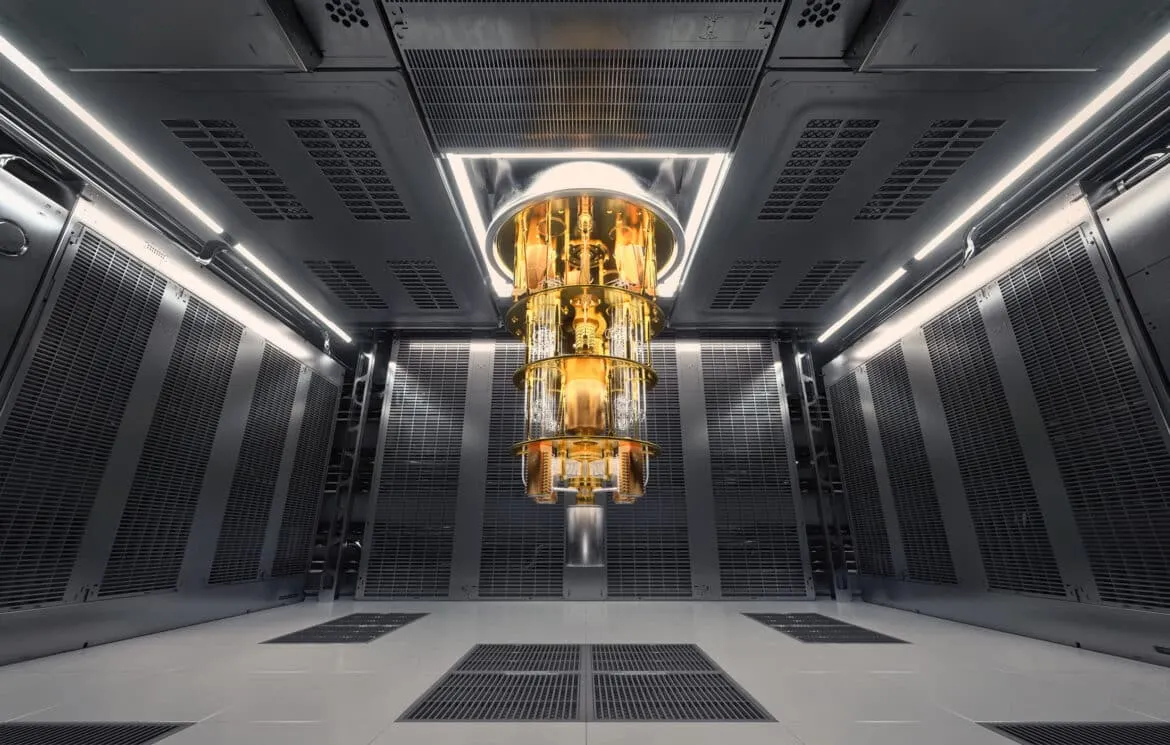
It’s all good to look fancy, I mean, that’s what the internet is all about right? It’s the illusion of a great lifestyle or the illusion of making a sh*t tone of money. So if we zoom in you’ll see the real quantum computer…
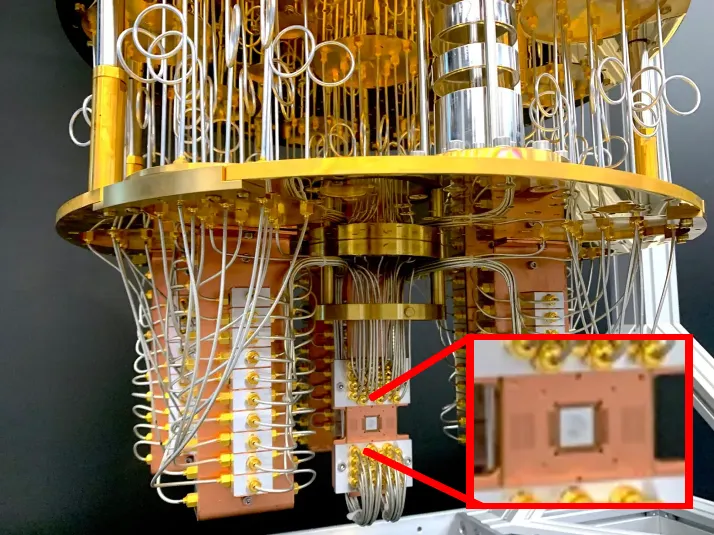
See that little microchip? I’ve zoomed in and put red around it for your convenience. That is the REAL quantum computer. Now, a lot of you will say “Oh come on! That’s a bit of a technicality, the WHOLE thing is the computer!” Well yes and no. It’s important to note, I feel, how impressive the technology is. That tiny chip can process an incomprehensible amount of data per nanosecond. Everything else you see in the photo is an elaborate life support system that is required to keep the quantum processor alive. So let me take you through the anatomy of the quantum computer. It’s bloody fascinating.
Life-Support System
To understand the beautiful process of how these machines work, you need to peel back the layers of this high-tech chandelier. Like I said before, the eyecatching suspended structure isn’t the computer itself, it is a powerful ecosystem that keeps that little chip from carking it (dying for my non Aussie friends).
Most of the leading quantum computers like those built by Google or IMB rely on superconducting qubits. These are macroscopic electrical circuits that use superconducing materials that operate a near absolute zero to act as artificial atoms. What happens is by pulsing microwave photons the circuit can be driven between a ground state, which is (0), the excited state, (1) or marvelously in a state of superposition where they can be in both states simultaneously! That’s what quantum computers are all about. Running multiple complex equations and calculations instantly by using this technique. The materials used in this process is normally aluminium, they need to have ZERO electrical resistance at ultra cold temperatures, this allows current to flow as pairs of electrons without losing energy.
Now, the overall structure is called a dilution refrigerator because it does what it says. Dilutes the temperature. The distinct gold plated levels are the dividers with each level significantly colder than the previous.
The Upper Decks

Starting at the very top of the machine you’ll find a pleasant standard room temperature, 20°C, and as you move down through the first gold plates mechanical coolers strip away the heat. So by the time you pass the second and third stages your hit with -269°C, which you’ll happily note is cooler than the empty void of space.
Nervous System
You might notice the dense forest of coaxial cables weaving through every layer of the chandelier, these copper wires carry microwave pulses from servers sitting in the room, down to the processor. The pulses are in themselves a complex ecosystem of code that tell the qubits how to behave, whether or not they flip, twist or entangle with their neighbours. Pretty interesting right?
The Coldest Place In The Universe
After all that, we grab our North Face jackets and make our way down to the coldest place in the universe, the mixing chamber. In the mixing chamber a special mixture of two helium isotopes are pumped through a cycle of evaporation and dilution to the point where it strips away the absolute last remnants of thermal energy. This region is a cool 0.01 degree above absolute zero for a very important reason. Any warmer and the ambient heat would smash the qubits like a sledgehammer and ruin their delicate quantum state.
Preventing Information Decay
What on Earth is information decay? Everything is encased in cylindrical shields made of high-permeability metals, used to get rid of unwanted electromagnetic fields. The quantum environment is so fragile that a single stray photon of light can cause decoherence, the catastrophic event where the quantum information instantly collapses back into ordinary 1s and 0s. Then it just reverts back to a normal boring computer 🙁
Wi-fi signals or even the Earth’s magnetic pull can interrupt this delicate balance.
The Actual Computer Part
Sitting at the bottom of the elaborate structure is the actual quantum computer. It’s in the red box in the image back up the page. That little chip is bolted to the coldest plate possible and sits inside a shielded square container. The QPU, Quantum Processing Unit is a helluva lot different to your classic silicon chips, like the ones in our phones, which only hold a billion static transistors. The QPU holds hundreds of custom designed superconducting loops that are frozen near absolute Zero which allows electricity to flow through them without ANY resistance whatsoever. And that my friends is how they do the mind bending quantum physics….stuff.
The Pillars of Quantum Creation
What stuff do they do exactly? Well inside that frozen chip a wonderland of quantum mechanics is taking place using three core principles that allows it to solve problems that would take a traditional supercomputer millions of years to calculate.
- Superposition: A normal computer works in bits, this is 0 or 1 and it can switch between them, a qubit however, can exist as a fluid combination of both simultaneously. I did a short video on this if you’d prefer to watch it here.«« Because it’s a bit hard to understand how qubits can do this. Imagine a spinning coin, it will exist as both heads and tails until you slam your hand down on it, finally choosing an option.
- Entanglement: Ok I’ll admit this part I DO NOT UNDERSTAND… Qubits can become linked, entangled, and it doesn’t matter how far apart they are. They could be hundreds of light years apart (apparently) and if you changed the state of one entangled qubit, its partner would react instantly. Just WILD. This allows the computer to process a vast web of possibilities instantaneously!
- Interference: Just when you thought it couldn’t get any crazier…the quantum algorithms use constructive interference to amplify the correct answer to a problem and destructive interference to cancel out millions of incorrect answers. Think of noise-cancelling headphones, they project a noise-cancelling signal, a soundwave, that eliminates the noise frequency.
Yes, But Can You Make It Smaller?
Probably not for a while right? The current anatomy of the quantum computer is what you see in the pictures, a chandelier-like structure with a cryogenic life-support system. But the field is evolving rapidly with scientists working on scaling down these systems by linking multiple chandeliers together. They’re also improving the error correction algos and even exploring an alternative architecture, like using particles of light instead of frozen circuits which would run them at room temperature. If you want to deep dive into them they are called photonic quantum computers.
Although they are in their infancy, quantum computers are helping redefine the way we analyze data and expanding our knowledge of the cosmos, we just need to keep our coats handy.
 Kate Bishop
 Adam Morris